Jump to content

Go Kart Mozart

Members
  • Posts

    2,834
  • Joined

  • Last visited

Profile Information

  • Gender
    Male
  • Location:
    Trumbull, CT elev 310'

Recent Profile Visitors

9,279 profile views
  1. To channel the late Johnny Cochran: "If the AIs don't commit, the storm ain't legit".
  2. With so much UL energy, I am wondering if we will see some weird semi-convective results, or unexpected mini-convergence zones. Something like....a general dusting with lollies to 8". The far east looks a bit more like a normal storm result.
  3. Vortex Dude...please post here more often, nice contributions!
  4. I can see the Canuck through 162. Looks like it is putting all its chips on wave 2.
  5. How about the mods wipe this thread out. Let a real weather fan start a new thread at the proper time. All this thread does is split the posts, doing a disservice to the group.
  6. Really no misses in those clusters...except the cutters! lol
  7. This is an academic exercise of course, but relating to my last post showing intense snow over me, take a look at this sounding, and note the incredibly skinny DGZ.
  8. This from Don Sutherland, the Paul DiPodesta of weather forecasting: Although the events are still outside ability of the operational guidance to reliably resolve the synoptic details, the 12z guidance continues to be encouraging. It it consistent with the ongoing and incredibly orderly pattern evolution that has been underway since the start of January. In that evolution, cold should begin to return next week. Afterward, as the PNA rises, opportunities for snowfall should begin to increase. As noted previously, both severe cold and significant snowfall are unlikely through at least mid-January. The transition to a more wintry pattern probably won't be completed by then. But shortly afterward, the probability of snowfall should increase. The probability of moderate or significant snowfalls would be higher if a PNA+ can develop and then be sustained. Arctic air might begin to get involved around or after January 20th. The overall consensus in the guidance is that a general WPO-/EPO-/AO- pattern will develop just after mid-month. Such patterns in combination with a PNA+ are 1.7 times more likely to see one or more days with a 4" or above snowfall than when combined with a PNA-. Regardless of the state of the PNA, those patterns have seen measurable snowfall nearly once every five days, which is 1.6X climatology (1980-2025). As for the 12z GFS's systems during the roughly 168-hour and 222-hour timeframes, it's far too soon to resolve details. That there's activity is sufficient. In general, if things progress as has often occurred during the kind of pattern evolution described above, a delay in the first event would allow the trough more time to sharpen before the storm's development/arrival. That would increase prospects of its having a more impactful track than shown on the 12z GFS. The second system, as things currently stands, likely has the higher probability of taking an impactful track. Although its solution is different, the latter timeframe has support from the GGEM. Model skill at that timeframe is low. For now, it's more useful to stick with the overall pattern progression described above, avoid speculating over synoptic details that the guidance cannot resolve at these timeframes, and leave the details concerning potential events for later. That there's potential is what's both important and encouraging.
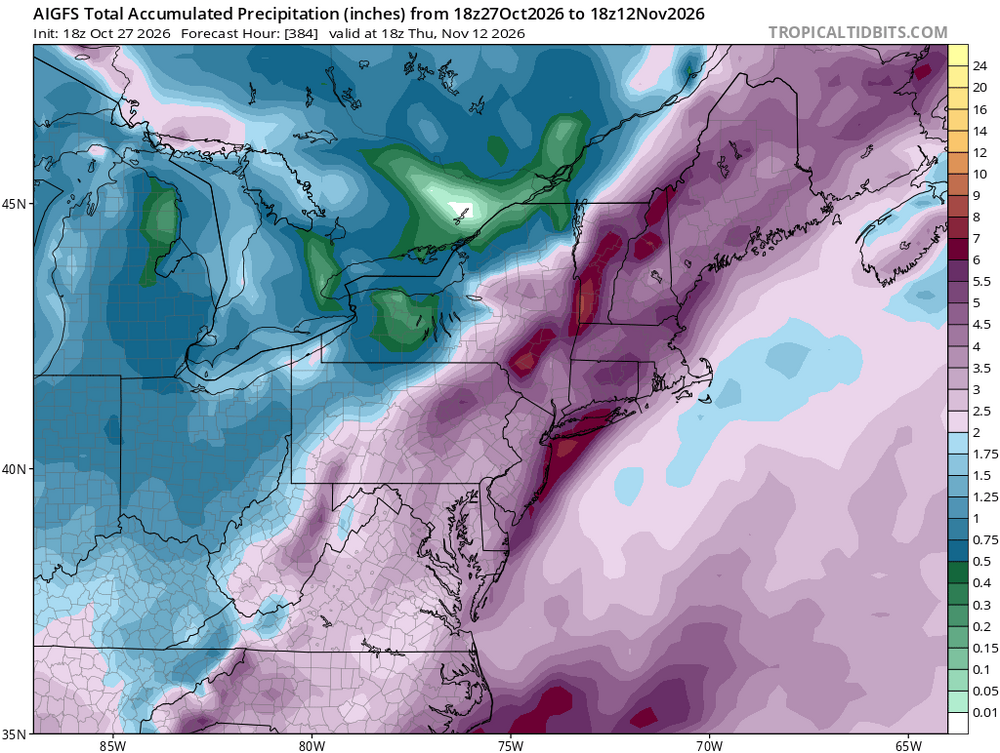
  9. AIs haven't really bitten at all, although AIGFS has a nasty looking negative tilted trough for the second "event".
×
×
  • Create New...