


donsutherland1
-
Posts
24,379 -
Joined
Content Type
Profiles
Blogs
Forums
American Weather
Media Demo
Store
Gallery
Everything posted by donsutherland1
-
DCA _ NYC _ BOS __ ORD _ ATL _ IAH ___ DEN _ PHX _ SEA 1.1 1.5 2.0 1.2 1.2 0.2 1.3 2.0 1.8
-
Seattle's Record Heatwave
donsutherland1 replied to donsutherland1's topic in Central/Western States
Today Seattle reached 90°, which set a new record high for today. It was also the 12th such temperature this year, which tied the record for most such days from 2015. -
A very warm August is concluding. Tomorrow will again see above normal temperatures. Newark is on track to record its second warmest summer on record. There is some chance it could see its warmest summer on record. Philadelphia will see either its second or third warmest summer on record. Above normal temperatures will likely continue through at least much of the first week of September. An intense heatwave that will continue into early September is now evolving in parts of the western U.S. and Canada. Portland reached 99°, which surpassed the record of 98° that was set in 1987. Salt Lake City reached 101°, which surpassed the old record set in 1954. Seattle reached 90° breaking the record of 88° from 1987. It was also Seattle's 12th 90° day of the year, which tied the record for most such days from 2015. Boise and Salt Lake City could see temperatures approach or reach September records. Death Valley will likely see multiple 120° or hotter days. The ECMWF seasonal forecast indicates that the summer will be warmer than normal throughout the region and across much of North America. Based on how the pattern has been evolving during the spring transition to summer, it is more likely than not that the warmest anomalies of the summer will likely occur in July and August with June being the coolest of the three months in the Northeast. In addition, in the 6 past cases when the June AO averaged +0.750 or above (1950-2021), 67% of the following August and September cases featured above normal temperatures. The August ECMWF forecast shows a warmer than normal September in the Northeast. This warmth would be consistent with the ongoing warming that has been occurring in September. On August 18, the SOI fell to -32.90. Since 1991, there were 8 cases when the SOI fell to -30 or below during the August 10-25 period. That outcome has often preceded a wetter than normal September in parts of the Northeast. Mean September rainfall figures for those 8 cases: Boston: 4.38" (normal: 3.55"); New York City: 5.08" (normal: 4.31"); and, Philadelphia: 5.12" (normal: 4.40"). Very wet years outnumbered very dry ones by a 2:1 ratio in Boston and 3:1 ratio in both New York City and Philadelphia. 63% of cases saw at least one day with 1" or more rainfall in Boston. 88% saw at least one day with 1" or more in New York City and Philadelphia. 50% of those cases saw at least one day with 2" or more daily rainfall in Philadelphia. In sum, the SOI may be offering a signal that there will be some drought relief for the northern Mid-Atlantic and southern New England regions in September. The recent passage of the MJO through Phase 2 at a very high amplitude (1.500 or above) during late August has introduced greater uncertainty. The ENSO Region 1+2 anomaly was -0.5°C and the Region 3.4 anomaly was -0.9°C for the week centered around August 24. For the past six weeks, the ENSO Region 1+2 anomaly has averaged -0.72°C and the ENSO Region 3.4 anomaly has averaged -0.93°C. La Niña conditions will likely persist through the fall. The SOI was +18.88 today. The preliminary Arctic Oscillation (AO) was -1.563 today. On August 28 the MJO was in Phase 2 at an amplitude of 1.865 (RMM). The August 27-adjusted amplitude was 1.930 (RMM). Based on sensitivity analysis applied to the latest guidance, there is an implied near 100% probability that New York City will have a warmer than normal August (1991-2020 normal). August will likely finish with a mean temperature near 79.4° (3.3° above normal).
-
Morning thoughts… It will be partly sunny and vey warm. High temperatures will reach the upper 80s and lower 90s in most of the region. Likely high temperatures around the region include: New York City (Central Park): 88° Newark: 91° Philadelphia: 92° Generally warmer than normal conditions will persist through at least much of the first week of September. Normals: New York City: 30-Year: 81.3°; 15-Year: 81.2° Newark: 30-Year: 82.7°; 15-Year: 82.7° Philadelphia: 30-Year: 83.9°; 15-Year: 83.6°
-
Tomorrow will be a hot day. Temperatures will rise into the upper 80s and lower 90s. Newark is on track to record its second warmest summer on record. There is some chance it could see its warmest summer on record. Philadelphia will see either its second or third warmest summer on record. The remainder of August will likely see generally above normal temperatures. Additional 90° or above days are possible in parts of the region. Above normal temperatures will likely continue through at least much of the first week of September. Late August and early September will see an intense heatwave develop in parts of the western U.S. and Canada. Boise and Salt Lake City could see temperatures approach or reach September records. The ECMWF seasonal forecast indicates that the summer will be warmer than normal throughout the region and across much of North America. Based on how the pattern has been evolving during the spring transition to summer, it is more likely than not that the warmest anomalies of the summer will likely occur in July and August with June being the coolest of the three months in the Northeast. In addition, in the 6 past cases when the June AO averaged +0.750 or above (1950-2021), 67% of the following August and September cases featured above normal temperatures. The August ECMWF forecast shows a warmer than normal September in the Northeast. This warmth would be consistent with the ongoing warming that has been occurring in September. On August 18, the SOI fell to -32.90. Since 1991, there were 8 cases when the SOI fell to -30 or below during the August 10-25 period. That outcome has often preceded a wetter than normal September in parts of the Northeast. Mean September rainfall figures for those 8 cases: Boston: 4.38" (normal: 3.55"); New York City: 5.08" (normal: 4.31"); and, Philadelphia: 5.12" (normal: 4.40"). Very wet years outnumbered very dry ones by a 2:1 ratio in Boston and 3:1 ratio in both New York City and Philadelphia. 63% of cases saw at least one day with 1" or more rainfall in Boston. 88% saw at least one day with 1" or more in New York City and Philadelphia. 50% of those cases saw at least one day with 2" or more daily rainfall in Philadelphia. In sum, the SOI may be offering a signal that there will be some drought relief for the northern Mid-Atlantic and southern New England regions in September. The recent passage of the MJO through Phase 2 at a very high amplitude (1.500 or above) during late August has introduced greater uncertainty. The ENSO Region 1+2 anomaly was -0.5°C and the Region 3.4 anomaly was -0.9°C for the week centered around August 24. For the past six weeks, the ENSO Region 1+2 anomaly has averaged -0.72°C and the ENSO Region 3.4 anomaly has averaged -0.93°C. La Niña conditions will likely persist through the fall. The SOI was +19.36 today. The preliminary Arctic Oscillation (AO) was -1.379 today. On August 27 the MJO was in Phase 2 at an amplitude of 1.930 (RMM). The August 26-adjusted amplitude was 1.898 (RMM). Based on sensitivity analysis applied to the latest guidance, there is an implied near 100% probability that New York City will have a warmer than normal August (1991-2020 normal). August will likely finish with a mean temperature near 79.4° (3.3° above normal).
-
Morning thoughts… It will be mostly sunny and vey warm. High temperatures will reach the upper 80s and lower 90s in most of the region. Likely high temperatures around the region include: New York City (Central Park): 87° Newark: 90° Philadelphia: 93° Generally warmer than normal conditions will persist through at least much of the first week of September. Normals: New York City: 30-Year: 81.5°; 15-Year: 81.3° Newark: 30-Year: 82.9°; 15-Year: 82.9° Philadelphia: 30-Year: 84.1°; 15-Year: 83.8°
-
Clouds held temperatures to the low 80s from Newark to New York City. Farther south, Philadelphia topped out at 91°. Temperatures will rebound tomorrow. Newark is on track to record its second warmest summer on record. There is some chance it could see its warmest summer on record. Philadelphia will see either its second or third warmest summer on record. The remainder of August will likely see generally above normal temperatures. Additional 90° or above days are possible in parts of the region. Above normal temperatures will likely continue through at least much of the first week of September. The ECMWF seasonal forecast indicates that the summer will be warmer than normal throughout the region and across much of North America. Based on how the pattern has been evolving during the spring transition to summer, it is more likely than not that the warmest anomalies of the summer will likely occur in July and August with June being the coolest of the three months in the Northeast. In addition, in the 6 past cases when the June AO averaged +0.750 or above (1950-2021), 67% of the following August and September cases featured above normal temperatures. The August ECMWF forecast shows a warmer than normal September in the Northeast. This warmth would be consistent with the ongoing warming that has been occurring in September. On August 18, the SOI fell to -32.90. Since 1991, there were 8 cases when the SOI fell to -30 or below during the August 10-25 period. That outcome has often preceded a wetter than normal September in parts of the Northeast. Mean September rainfall figures for those 8 cases: Boston: 4.38" (normal: 3.55"); New York City: 5.08" (normal: 4.31"); and, Philadelphia: 5.12" (normal: 4.40"). Very wet years outnumbered very dry ones by a 2:1 ratio in Boston and 3:1 ratio in both New York City and Philadelphia. 63% of cases saw at least one day with 1" or more rainfall in Boston. 88% saw at least one day with 1" or more in New York City and Philadelphia. 50% of those cases saw at least one day with 2" or more daily rainfall in Philadelphia. In sum, the SOI may be offering a signal that there will be some drought relief for the northern Mid-Atlantic and southern New England regions in September. The recent passage of the MJO through Phase 2 at a very high amplitude (1.500 or above) during late August has introduced greater uncertainty. The ENSO Region 1+2 anomaly was -0.8°C and the Region 3.4 anomaly was -1.2°C for the week centered around August 10. For the past six weeks, the ENSO Region 1+2 anomaly has averaged -0.83°C and the ENSO Region 3.4 anomaly has averaged -0.88°C. La Niña conditions will likely persist through the fall. The SOI was +16.20 today. The preliminary Arctic Oscillation (AO) was -0.882 today. On August 26 the MJO was in Phase 2 at an amplitude of 1.898 (RMM). The August 25-adjusted amplitude was 1.768 (RMM). Based on sensitivity analysis applied to the latest guidance, there is an implied near 100% probability that New York City will have a warmer than normal August (1991-2020 normal). August will likely finish with a mean temperature near 79.3° (3.2° above normal).
-
Morning thoughts… Clouds will give way to partly sunny conditions. High temperatures will reach the lower and middle 80s in most of the region. Likely high temperatures around the region include: New York City (Central Park): 82° Newark: 85° Philadelphia: 89° Generally warmer than normal conditions will persist through at least much of the first week of September. Normals: New York City: 30-Year: 81.7°; 15-Year: 81.3° Newark: 30-Year: 82.9°; 15-Year: 82.9° Philadelphia: 30-Year: 84.1°; 15-Year: 83.8°
-
Today saw temperatures again reach the upper 80s and lower 90s in much of the region. High temperatures included: Allentown: 87° Baltimore: 90° Bridgeport: 86° Islip: 90° New York City: 90° Newark: 91° Philadelphia: 93° Washington, DC: 91° Newark is on track to record its second warmest summer on record. Philadelphia will see either its second or third warmest summer on record. Tomorrow will be somewhat cooler than today was. However, the remainder of August will likely see generally above normal temperatures. Additional 90° or above days are possible in parts of the region. Above normal temperatures will likely continue through at least much of the first week of September. The ECMWF seasonal forecast indicates that the summer will be warmer than normal throughout the region and across much of North America. Based on how the pattern has been evolving during the spring transition to summer, it is more likely than not that the warmest anomalies of the summer will likely occur in July and August with June being the coolest of the three months in the Northeast. In addition, in the 6 past cases when the June AO averaged +0.750 or above (1950-2021), 67% of the following August and September cases featured above normal temperatures. The August ECMWF forecast shows a warmer than normal September in the Northeast. This warmth would be consistent with the ongoing warming that has been occurring in September. On August 18, the SOI fell to -32.90. Since 1991, there were 8 cases when the SOI fell to -30 or below during the August 10-25 period. That outcome has often preceded a wetter than normal September in parts of the Northeast. Mean September rainfall figures for those 8 cases: Boston: 4.38" (normal: 3.55"); New York City: 5.08" (normal: 4.31"); and, Philadelphia: 5.12" (normal: 4.40"). Very wet years outnumbered very dry ones by a 2:1 ratio in Boston and 3:1 ratio in both New York City and Philadelphia. 63% of cases saw at least one day with 1" or more rainfall in Boston. 88% saw at least one day with 1" or more in New York City and Philadelphia. 50% of those cases saw at least one day with 2" or more daily rainfall in Philadelphia. In sum, the SOI may be offering a signal that there will be some drought relief for the northern Mid-Atlantic and southern New England regions in September. The ENSO Region 1+2 anomaly was -0.8°C and the Region 3.4 anomaly was -1.2°C for the week centered around August 10. For the past six weeks, the ENSO Region 1+2 anomaly has averaged -0.83°C and the ENSO Region 3.4 anomaly has averaged -0.88°C. La Niña conditions will likely persist through the fall. The SOI was +6.68 today. The preliminary Arctic Oscillation (AO) was -0.305 today. On August 25 the MJO was in Phase 2 at an amplitude of 1.773 (RMM). The August 24-adjusted amplitude was 1.644 (RMM). Based on sensitivity analysis applied to the latest guidance, there is an implied near 100% probability that New York City will have a warmer than normal August (1991-2020 normal). August will likely finish with a mean temperature near 79.3° (3.2° above normal).
-
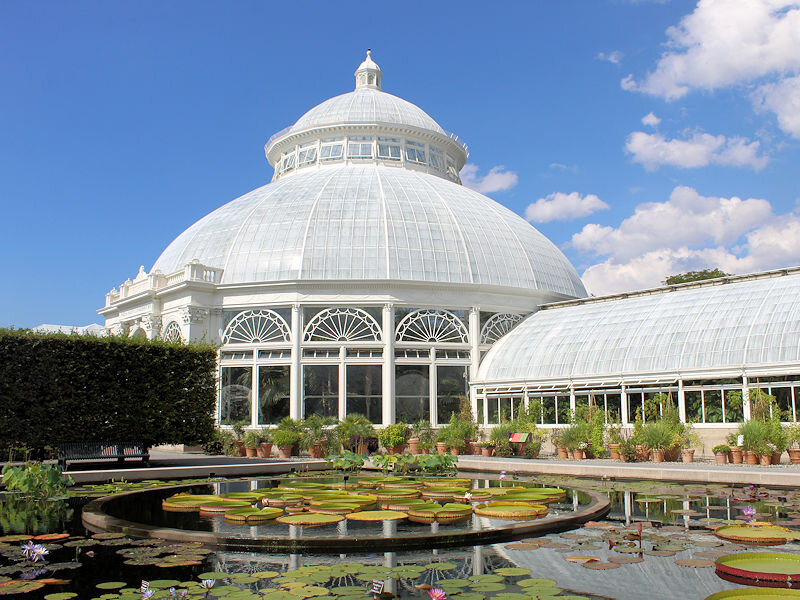
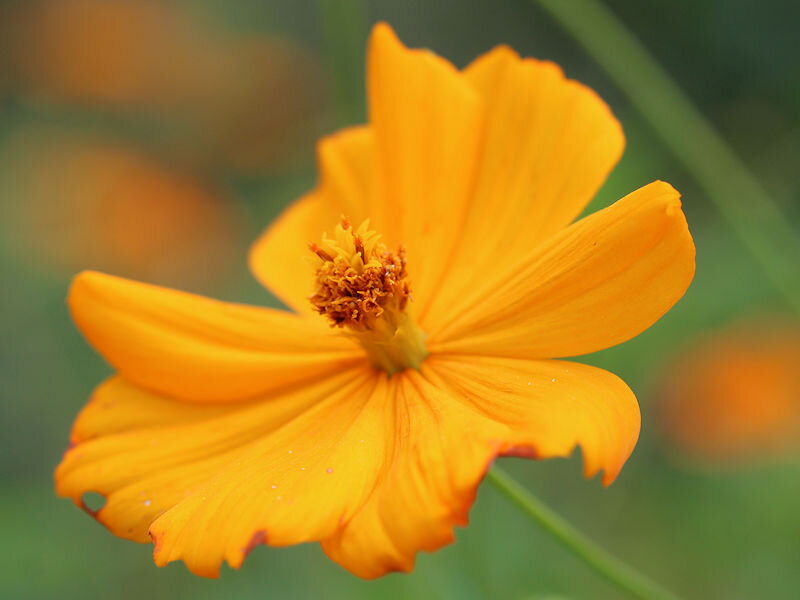
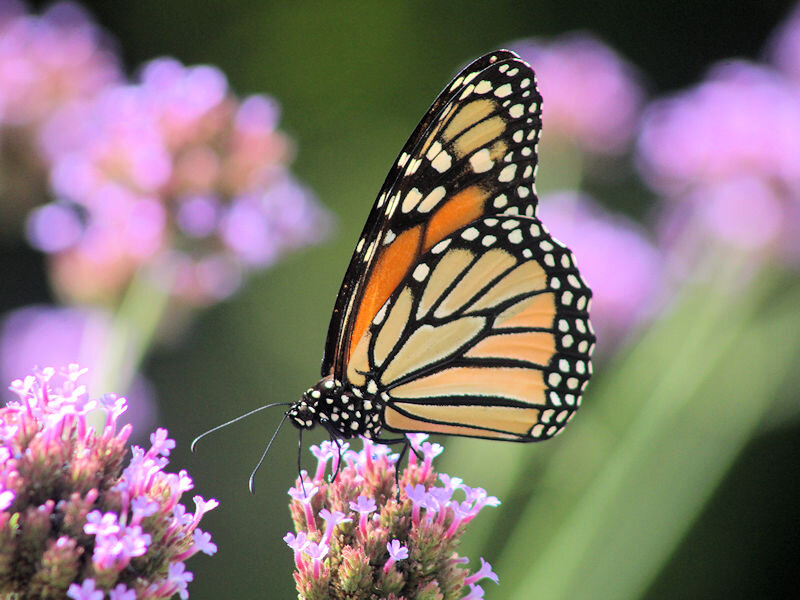
In New York City, the temperature soared to 90°F today. At the New York Botanical Garden, flowers were in abundance and butterflies were plentiful.


-
Morning thoughts… It will be partly cloudy and very warm. High temperatures will reach the middle and upper 80s in most of the region. A few hot spots could reach 90°. Likely high temperatures around the region include: New York City (Central Park): 86° Newark: 90° Philadelphia: 91° The remainder of August will likely see generally warmer than normal conditions. Normals: New York City: 30-Year: 81.9°; 15-Year: 81.7° Newark: 30-Year: 83.3°; 15-Year: 83.3° Philadelphia: 30-Year: 84.5°; 15-Year: 84.1°
-
Temperatures again rose into the upper 80s and lower 90s across the region. A few areas saw thunderstorms. Drought-stricken Boston, which had its lowest May 1-August 25 rainfall on record, picked up 0.41" of rain. The remainder of August will likely see generally above normal temperatures. Additional 90° or above days are possible in parts of the region. The ECMWF seasonal forecast indicates that the summer will be warmer than normal throughout the region and across much of North America. Based on how the pattern has been evolving during the spring transition to summer, it is more likely than not that the warmest anomalies of the summer will likely occur in July and August with June being the coolest of the three months in the Northeast. In addition, in the 6 past cases when the June AO averaged +0.750 or above (1950-2021), 67% of the following August and September cases featured above normal temperatures. The August ECMWF forecast shows a warmer than normal September in the Northeast. This warmth would be consistent with the ongoing warming that has been occurring in September. On August 18, the SOI fell to -32.90. Since 1991, there were 8 cases when the SOI fell to -30 or below during the August 10-25 period. That outcome has often preceded a wetter than normal September in parts of the Northeast. Mean September rainfall figures for those 8 cases: Boston: 4.38" (normal: 3.55"); New York City: 5.08" (normal: 4.31"); and, Philadelphia: 5.12" (normal: 4.40"). Very wet years outnumbered very dry ones by a 2:1 ratio in Boston and 3:1 ratio in both New York City and Philadelphia. 63% of cases saw at least one day with 1" or more rainfall in Boston. 88% saw at least one day with 1" or more in New York City and Philadelphia. 50% of those cases saw at least one day with 2" or more daily rainfall in Philadelphia. In sum, the SOI may be offering a signal that there will be some drought relief for the northern Mid-Atlantic and southern New England regions in September. The ENSO Region 1+2 anomaly was -0.8°C and the Region 3.4 anomaly was -1.2°C for the week centered around August 10. For the past six weeks, the ENSO Region 1+2 anomaly has averaged -0.83°C and the ENSO Region 3.4 anomaly has averaged -0.88°C. La Niña conditions will likely persist through the fall. The SOI was -5.64 today. The preliminary Arctic Oscillation (AO) was -0.210 today. On August 24 the MJO was in Phase 2 at an amplitude of 1.647 (RMM). The August 23-adjusted amplitude was 1.586 (RMM). Based on sensitivity analysis applied to the latest guidance, there is an implied near 100% probability that New York City will have a warmer than normal August (1991-2020 normal). August will likely finish with a mean temperature near 79.2° (3.1° above normal). Finally, on August 25, Arctic sea ice extent was 5.174 million square kilometers (JAXA). There is an implied 95% probability that Arctic sea ice extent will reach a minimum figure below 5.000 million square kilometers for the 13th consecutive year. The highest 25% bound is 4.791 million square kilometers. The lowest 25% bound is 4.486 million square kilometers.
-
Morning thoughts… It will be partly cloudy and very warm. High temperatures will reach the upper 80s and lower 90s in most of the region. Likely high temperatures around the region include: New York City (Central Park): 89° Newark: 91° Philadelphia: 92° The remainder of August will likely see generally warmer than normal conditions. Normals: New York City: 30-Year: 82.1°; 15-Year: 81.9° Newark: 30-Year: 83.5°; 15-Year: 83.4° Philadelphia: 30-Year: 84.6°; 15-Year: 84.3°
-
Information without context is meaningless. And relying on a 46-day forecast can be risky. Here's how things actually turned out: the warmth was a lot more widespread.
-
Today was another hot day. Many locations from New York City to Philadelphia saw the temperature soar to 90° or above. The remainder of August will likely see generally above normal temperatures. Additional 90° or above days are possible in parts of the region. The ECMWF seasonal forecast indicates that the summer will be warmer than normal throughout the region and across much of North America. Based on how the pattern has been evolving during the spring transition to summer, it is more likely than not that the warmest anomalies of the summer will likely occur in July and August with June being the coolest of the three months in the Northeast. In addition, in the 6 past cases when the June AO averaged +0.750 or above (1950-2021), 67% of the following August and September cases featured above normal temperatures. The August ECMWF forecast shows a warmer than normal September in the Northeast. This warmth would be consistent with the ongoing warming that has been occurring in September. On August 18, the SOI fell to -32.90. Since 1991, there were 8 cases when the SOI fell to -30 or below during the August 10-25 period. That outcome has often preceded a wetter than normal September in parts of the Northeast. Mean September rainfall figures for those 8 cases: Boston: 4.38" (normal: 3.55"); New York City: 5.08" (normal: 4.31"); and, Philadelphia: 5.12" (normal: 4.40"). Very wet years outnumbered very dry ones by a 2:1 ratio in Boston and 3:1 ratio in both New York City and Philadelphia. 63% of cases saw at least one day with 1" or more rainfall in Boston. 88% saw at least one day with 1" or more in New York City and Philadelphia. 50% of those cases saw at least one day with 2" or more daily rainfall in Philadelphia. In sum, the SOI may be offering a signal that there will be some drought relief for the northern Mid-Atlantic and southern New England regions in September. The ENSO Region 1+2 anomaly was -0.8°C and the Region 3.4 anomaly was -1.2°C for the week centered around August 10. For the past six weeks, the ENSO Region 1+2 anomaly has averaged -0.83°C and the ENSO Region 3.4 anomaly has averaged -0.88°C. La Niña conditions will likely persist through the fall. The SOI was -9.04 today. The preliminary Arctic Oscillation (AO) was -0.728 today. On August 23 the MJO was in Phase 2 at an amplitude of 1.586 (RMM). The August 22-adjusted amplitude was 1.229 (RMM). Based on sensitivity analysis applied to the latest guidance, there is an implied near 100% probability that New York City will have a warmer than normal August (1991-2020 normal). August will likely finish with a mean temperature near 79.1° (3.0° above normal).
-
Morning thoughts… It will be partly cloudy and hot. High temperatures will reach the upper 80s and lower 90s in most of the region. Likely high temperatures around the region include: New York City (Central Park): 90° Newark: 92° Philadelphia: 91° The remainder of August will likely see generally warmer than normal conditions. Normals: New York City: 30-Year: 82.3°; 15-Year: 82.0° Newark: 30-Year: 83.6°; 15-Year: 83.6° Philadelphia: 30-Year: 84.8°; 15-Year: 84.0°
-
Temperatures in the region reached the upper 80s and lower 90s. New York City, Newark, and New York City all reached 90°. The remainder of August will likely see generally above normal temperatures. Additional 90° or above days are possible in parts of the region. At Tampa, the mercury reached 95°. That tied the daily record set in 1975 and tied in 2014 and 2019. More impressively, it was Tampa's 25th such temperature this year. That broke the longstanding annual record of 24 days, which had stood since 1990. With Tampa's 30-year mean summer temperature having exceeded 82.5°, more than half of recent summers have exceeded the 90th percentile for heat. The ECMWF seasonal forecast indicates that the summer will be warmer than normal throughout the region and across much of North America. Based on how the pattern has been evolving during the spring transition to summer, it is more likely than not that the warmest anomalies of the summer will likely occur in July and August with June being the coolest of the three months in the Northeast. In addition, in the 6 past cases when the June AO averaged +0.750 or above (1950-2021), 67% of the following August and September cases featured above normal temperatures. The August ECMWF forecast shows a warmer than normal September in the Northeast. This warmth would be consistent with the ongoing warming that has been occurring in September. On August 18, the SOI fell to -32.90. Since 1991, there were 8 cases when the SOI fell to -30 or below during the August 10-25 period. That outcome has often preceded a wetter than normal September in parts of the Northeast. Mean September rainfall figures for those 8 cases: Boston: 4.38" (normal: 3.55"); New York City: 5.08" (normal: 4.31"); and, Philadelphia: 5.12" (normal: 4.40"). Very wet years outnumbered very dry ones by a 2:1 ratio in Boston and 3:1 ratio in both New York City and Philadelphia. 63% of cases saw at least one day with 1" or more rainfall in Boston. 88% saw at least one day with 1" or more in New York City and Philadelphia. 50% of those cases saw at least one day with 2" or more daily rainfall in Philadelphia. In sum, the SOI may be offering a signal that there will be some drought relief for the northern Mid-Atlantic and southern New England regions in September. The ENSO Region 1+2 anomaly was -0.8°C and the Region 3.4 anomaly was -1.2°C for the week centered around August 10. For the past six weeks, the ENSO Region 1+2 anomaly has averaged -0.83°C and the ENSO Region 3.4 anomaly has averaged -0.88°C. La Niña conditions will likely persist through the fall. The SOI was +5.58 today. The preliminary Arctic Oscillation (AO) was -0.786 today. On August 22 the MJO was in Phase 2 at an amplitude of 1.237 (RMM). The August 21-adjusted amplitude was 1.078 (RMM). Based on sensitivity analysis applied to the latest guidance, there is an implied near 100% probability that New York City will have a warmer than normal August (1991-2020 normal). August will likely finish with a mean temperature near 79.0° (2.9° above normal).
-
The years are: 1991, 1996, 1997, 2002, 2004, 2006, 2015, and 2018.
-
Morning thoughts… It will be partly cloudy and very warm. A shower or thundershower is possible. High temperatures will reach the upper 80s and lower 90s in most of the region. Likely high temperatures around the region include: New York City (Central Park): 88° Newark: 91° Philadelphia: 91° The remainder of August will likely see generally warmer than normal conditions. Normals: New York City: 30-Year: 82.5°; 15-Year: 82.2° Newark: 30-Year: 83.8°; 15-Year: 83.8° Philadelphia: 30-Year: 85.0°; 15-Year: 84.6°
-
Temperatures rebounded into the middle and upper 80s today with the return of sunshine. The remainder of August will likely see generally above normal temperatures. Addional 90° or above days ae possible in parts of the region. Out West, Salt Lake City reached 100° for the 25th time this year. The old record was 21 days. That record was set in 1960 and tied in 1994 and 2021. During 1961-1990, Salt Lake City averaged 5.2 100° days per year. During 1991-2020, that figure had increased to 7.6 days. The most recent 30-year period (1993-2022) is averaging 8.9 such days per year. The ECMWF seasonal forecast indicates that the summer will be warmer than normal throughout the region and across much of North America. Based on how the pattern has been evolving during the spring transition to summer, it is more likely than not that the warmest anomalies of the summer will likely occur in July and August with June being the coolest of the three months in the Northeast. In addition, in the 6 past cases when the June AO averaged +0.750 or above (1950-2021), 67% of the following August and September cases featured above normal temperatures. The August ECMWF forecast shows a warmer than normal September in the Northeast. This warmth would be consistent with the ongoing warming that has been occurring in September. On August 18, the SOI fell to -32.90. Since 1991, there were 8 cases when the SOI fell to -30 or below during the August 10-25 period. That outcome has often preceded a wetter than normal September in parts of the Northeast. Mean September rainfall figures for those 8 cases: Boston: 4.38" (normal: 3.55"); New York City: 5.08" (normal: 4.31"); and, Philadelphia: 5.12" (normal: 4.40"). Very wet years outnumbered very dry ones by a 2:1 ratio in Boston and 3:1 ratio in both New York City and Philadelphia. 63% of cases saw at least one day with 1" or more rainfall in Boston. 88% saw at least one day with 1" or more in New York City and Philadelphia. 50% of those cases saw at least one day with 2" or more daily rainfall in Philadelphia. In sum, the SOI may be offering a signal that there will be some drought relief for the northern Mid-Atlantic and southern New England regions in September. The ENSO Region 1+2 anomaly was -0.8°C and the Region 3.4 anomaly was -1.2°C for the week centered around August 10. For the past six weeks, the ENSO Region 1+2 anomaly has averaged -0.83°C and the ENSO Region 3.4 anomaly has averaged -0.88°C. La Niña conditions will likely persist through the fall. The SOI was +16.81 today. The preliminary Arctic Oscillation (AO) was -0.713 today. On August 21 the MJO was in Phase 1 at an amplitude of 1.079 (RMM). The August 20-adjusted amplitude was 0.826 (RMM). Based on sensitivity analysis applied to the latest guidance, there is an implied 99% probability that New York City will have a warmer than normal August (1991-2020 normal). August will likely finish with a mean temperature near 78.9° (2.8° above normal).
-
Morning thoughts… It will be partly cloudy and warmer. A shower or thundershower is possible. High temperatures will reach the middle and upper 80s in most of the region. Likely high temperatures around the region include: New York City (Central Park): 84° Newark: 88° Philadelphia: 88° The remainder of August will likely see generally warmer than normal conditions. Normals: New York City: 30-Year: 82.6°; 15-Year: 82.3° Newark: 30-Year: 84.0°; 15-Year: 84.0° Philadelphia: 30-Year: 85.1°; 15-Year: 84.7°
-
Some statistics from Dallas-Fort Worth's extreme rain event: - One-day total: 5.66" (new August record & 5th highest daily figure) - Two-day total: 9.19" (new August 2- and 3-day record; 4th highest 2-day total) - Hourly rainfall: 3.01" (new hourly record)
-
Tomorrow will see additional showers and thunderstorms. Much of the region remains on track for two-day rainfall of 0.50"-1.00" with locally higher amounts through tomorrow. Long Island could wind up on the drier side. Out West, Dallas-Fort Worth picked up 5.66" rain today. That set a new August record and was the 5th highest daily figure on record. Two-day rainfall of 9.19" surpassed the August monthly two-day record (6.95", August 17-18, 1915) and 3-day record (7.04", August 17-19, 1915) and was the 4th highest on record. The ECMWF seasonal forecast indicates that the summer will be warmer than normal throughout the region and across much of North America. Based on how the pattern has been evolving during the spring transition to summer, it is more likely than not that the warmest anomalies of the summer will likely occur in July and August with June being the coolest of the three months in the Northeast. In addition, in the 6 past cases when the June AO averaged +0.750 or above (1950-2021), 67% of the following August and September cases featured above normal temperatures. The August ECMWF forecast shows a warmer than normal September in the Northeast. This warmth would be consistent with the ongoing warming that has been occurring in September. On August 18, the SOI fell to -32.90. Since 1991, there were 8 cases when the SOI fell to -30 or below during the August 10-25 period. That outcome has often preceded a wetter than normal September in parts of the Northeast. Mean September rainfall figures for those 8 cases: Boston: 4.38" (normal: 3.55"); New York City: 5.08" (normal: 4.31"); and, Philadelphia: 5.12" (normal: 4.40"). Very wet years outnumbered very dry ones by a 2:1 ratio in Boston and 3:1 ratio in both New York City and Philadelphia. 63% of cases saw at least one day with 1" or more rainfall in Boston. 88% saw at least one day with 1" or more in New York City and Philadelphia. 50% of those cases saw at least one day with 2" or more daily rainfall in Philadelphia. In sum, the SOI may be offering a signal that there will be some drought relief for the northern Mid-Atlantic and southern New England regions in September. The ENSO Region 1+2 anomaly was -0.8°C and the Region 3.4 anomaly was -1.2°C for the week centered around August 10. For the past six weeks, the ENSO Region 1+2 anomaly has averaged -0.83°C and the ENSO Region 3.4 anomaly has averaged -0.88°C. La Niña conditions will likely persist through the fall. The SOI was +12.68 today. The preliminary Arctic Oscillation (AO) was -0.574 today. On August 20 the MJO was in Phase 1 at an amplitude of 0.827 (RMM). The August 19-adjusted amplitude was 0.600 (RMM). Based on sensitivity analysis applied to the latest guidance, there is an implied 97% probability that New York City will have a warmer than normal August (1991-2020 normal). August will likely finish with a mean temperature near 78.7° (2.6° above normal).
-
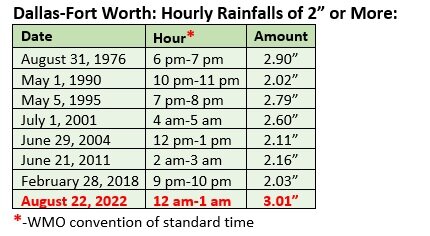
Earlier, an hourly record 3.01” of rain fell at Dallas-Fort Worth. Hourly records go back to 1953.
-
Through 10:00 am CDT, Dallas-Fort Worth has picked up 4.36" of rain. That smashes the daily record of 2.47" for August 22nd, which was set in 1916. It also surpasses the August daily record of 4.28", which was set on August 28, 1946. The 2-day total of 7.89” also surpasses the 2- and 3-day records for August.

