
Floydbuster
-
Posts
3,132 -
Joined
-
Last visited
Content Type
Profiles
Blogs
Forums
American Weather
Media Demo
Store
Gallery
Everything posted by Floydbuster
-
There is already discussions about what happens should a Greek name warrant retirement. Some say just add it to the list as "DELTA 2020" or something but keep the name for future usage. I have another idea. How about create an auxiliary list of names that can be replaced if need be? I think using colors would be a good idea. Of course without using possibly sensitive ones like black or white or brown. Maybe something like this: Auburn Bronze Copper Denim Emerald Fuchsia Gold Hickory Indigo Jade Khaki Lavender Maroon Neon Orchid Pink Ruby Saffron Teal Violet Walnut I came up with those quickly, and if you ever needed replacement names, here's a second list: Aqua Beige Crimson Dogwood Eggplant Frost Green Hibiscus Ivory Julep Kiwi Lilac Mint Nickel Orange Purple Rust Slate Turquoise Viridian Wisteria Thoughts?
-
Yes, it's a Spanish female name. It's pronounced: See-Oh-Ma-Rah
-
I can't believe we are gonna hit the Greek names. I don't like changing things set in stone, as our hurricane name lists have been for over 40 years. However, I think adding three additional letters to the Atlantic name lists would be a good way to prevent frequent exhaustion of the name list, as well as media sensationalism. This is already done in the Eastern Pacific. The Eastern Pacific uses the letters X, Y and Z. They have one female name for each letter, and one male name for each letter, and alternate them every two years rather than the way the main name list alternates every six years. I think adding those three letters to the Atlantic lists would be simple, and their infrequent usage and only needing a total of six different names for all six lists would make the situation much easier. So I'm proposing something like this: Any thoughts?
-
Yes. You'd have to come up with three male Q names for the Atlantic, three female Q names for the Atlantic. Then another three male Q names for the Eastern Pacific, then another three female Q names for the Pacific. I guess you could alternate like the Eastern Pacific does with Xina, Xavier, Zeke, Zelda, Yolanda and York every two years...but who knows.
-
I always assume that a Miami Cat 4-type hurricane isn't very likely after September 20th. Hurricane King in 1950 was a Cat 4 in October, and Hurricane Matthew came close October 2016. Of course we had Hurricane Michael strike the Panhandle as a strengthening Cat 5 in October, but that was likely an anomaly of historic proportions. The Great Miami Hurricane and the Lake Okechobee Hurricane struck on September 18th and September 16th. There is still that window for a major SE Florida strike. Watch the wave leaving in a few days.
-
I was thinking a NC landfall and then out to sea, but yeah. Looks interesting.
-
Any idea why the waves are screwing around and not progressing westward?
-
Does anyone have any realistic ideas as to why the models have been so awful on genesis? Showing an El Nino-type year when we're already damn near exhausting the name list by Sept 4th?
-
It screws around offshore ala Juan 1985.
-
I already look back on this hurricane season as memorable. There were hardly any lulls, even early storms like Cristobal and Gonzalo were exciting enough to track. Hurricane Hanna was a nasty landfall in Texas in July with a pressure in the 970s. Hurricane Isaias surprised us with the last minute intensification before striking North Carolina and causing impressive storm surge in Myrtle Beach. Then we had a devastating high-end Cat 4 landfall on the North Gulf Coast in August. To me, that's a memorable hurricane season, and I think we likely have a few more memorable storms to go. I just hope we don't exhaust the name list too quickly, who the hell wants to track a late-season Caribbean storm named "Eta".
-
How is this not a tropical storm? Was recon out today? Did I miss it?
-
How can the models be showing such a dead pattern?
-
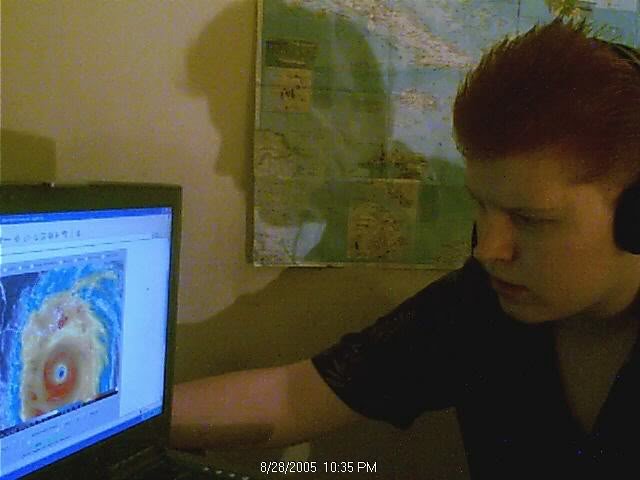
15 years ago at this very minute, tracking Katrina.
-
What the hell is wrong with the genesis on these models?
-
The EURO shows a hurricane barreling towards the Bahamas by Sept 3rd.
-
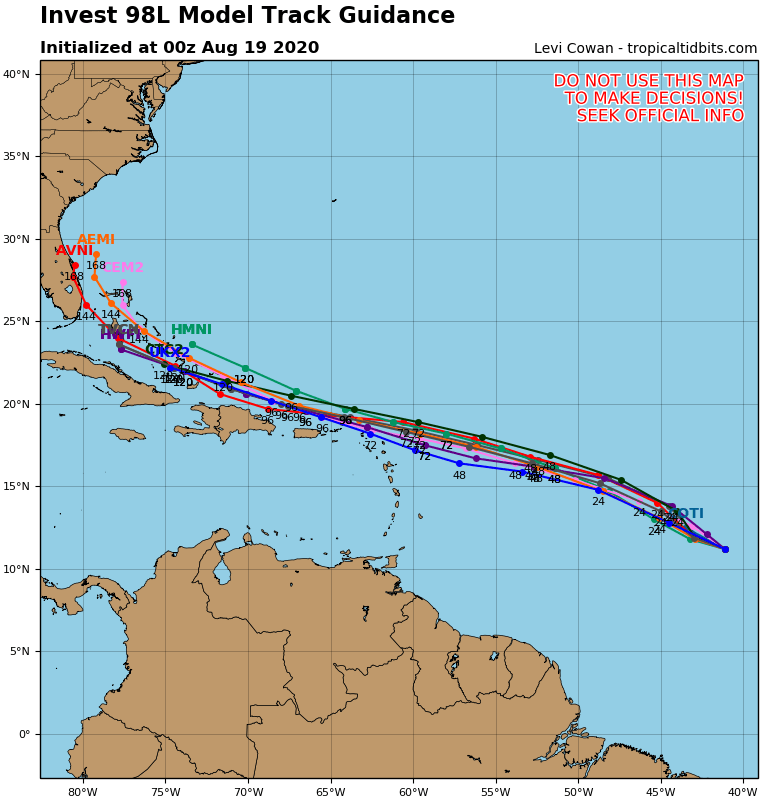
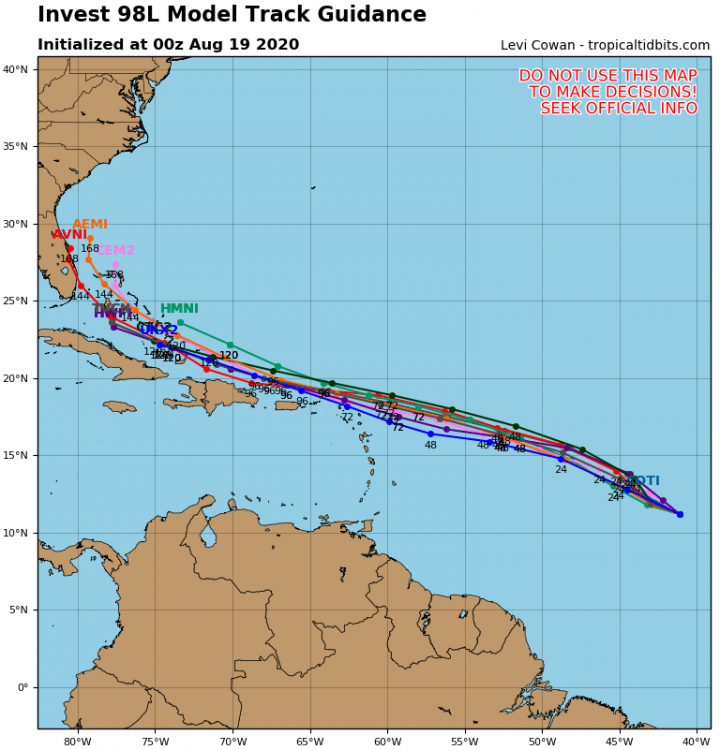
Serious question: Why do you seem so negative about the chances of 97L and (in particular) 98L? The National Hurricane Center is giving them both almost "certain" development chances, and technically they could both wind up becoming hurricanes. In fact, I think 98L is our most likely contender for the first major hurricane of the year. The wave over Africa is also moving off at just the right time. Last 10 days of August, MJO moving into favorable phase, rapidly decreasing wind shear conditions, increasing upper-level divergence and low level convergence. Significant moisture leaving Africa compared to the dustbowl we saw last month. So why so negative? I could understand if it were July and the SAL was everywhere, but these models are pretty damn tight for 5-7 days out, and that track in late August in a season like this screams major hurricane.
-
That CMC run is terrifying.
-
NHC now up to 40% for both.
-
Well the GFS now shows it becoming a hurricane striking the Yucatan and Mexico in 8-10 days, too. So you have the CMC, GFS and ICON. I'm just trying to put all the cards out on the table. I did say "for what it's worth".
-
For what it's worth, the ICON model now also shows our two new hurricanes, one rapidly strengthening crossing Western Cuba (similar path to Charley) and the other gradually strengthening moving through the Leeward Islands.
-
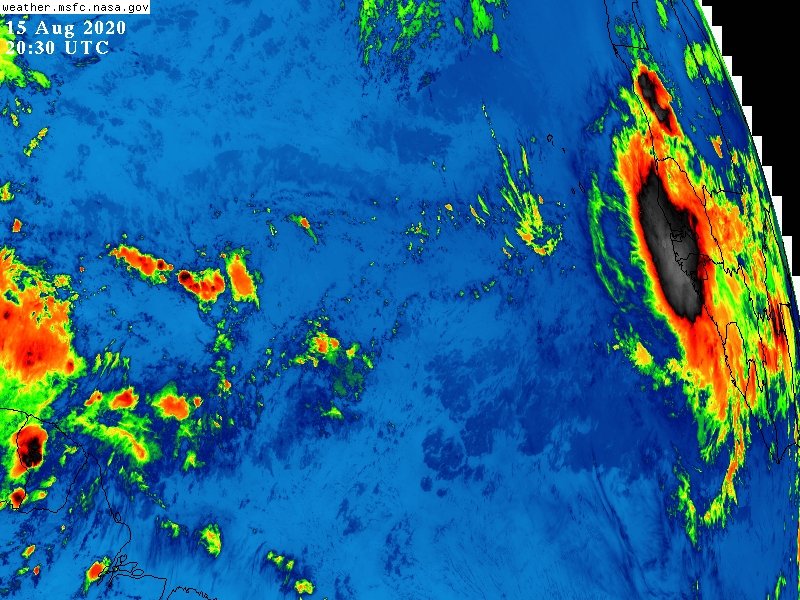
The CMC seems to be picking up on the weak wave in the Central Atlantic, as it enters warmer waters and a more moist environment. Shows it becoming a hurricane striking Southwest Florida in a week or so. The wave leaving Africa now becomes another hurricane striking the Virgin Islands. It's possible, there are definite entities there right now, and both are looking slightly more organized today.
-
Here's the deal. 2005 was an epic, historically rare meteorological event. Windspeed and I were actually hanging out at a hurricane conference in Florida in May of that year discussing the abnormally low wind shear, excessively hot sea surface temperatures and a satellite image of the Atlantic basin on May 17, 2005 that looked more like a satellite for mid-late July. We knew it would be crazy, and coming off the ravaging of the 2004 hurricane season, the anticipation was higher than you can imagine. I actually remember Windspeed telling me, "Mike, I think we may eventually see a Hurricane "Mitch" type storm with 180 mph winds in the Gulf of Mexico in the next few years...maybe even this year with those crazy SSTs." The fact that Hurricanes Katrina and in particular Rita then rivaled Mitch in the Gulf just 3/4 months later was unimaginable. I also remember us discussing the likelihood of a major hurricane in July, since conditions already seemed so prime. Little did we expect two hurricanes of Category 4 and 5 intensity ravaging the Western Caribbean, Mexico, Cuba and Florida by July 20th. Almost 30 named storms? Four Category 5 storms? Give me a break. I was 17 years old. I might see that again if I'm an old man with a huge head of white hair. 2005 was an epic season not seen since 1933. That type of year is almost unbelievable. The chances of it happening even during hyperactive seasons is unlikely. 1. This has been, and looks to be, a very-severe record breaking hurricane season. This is backed up by the fact that we have outpaced the records of 2005 for number of named storms, have extremely high oceanic heat content anomalies, forecasts of very lower-than-normal wind shear during the heart of the season, above average rainfall over Africa, and a likely extremely favorable MJO push from late August through mid-September. Add to this what appears to be a possible troublesome pattern for U.S. landfalls including having already seen the landfalls of two potent hurricanes and three tropical storms, this season is ringing alarm bells. Indeed, I believe this is the first time Dr. Klotzbach has forecast the Greek Alphabet since we used it back in 2005. Even if we didn't name two or three weak and short lived storms (Bertha, Dolly and Edouard), we would still be tracking the "G" storm, which would put us at roughly the level 2005 had at this point. So while it's not "2005" just the fact that it's rivaling 2005 in the number of named storms is disturbing because of how active that means things are. 2. Intense Julys aren't always harbingers of active seasons, but they often are. 1996 had two July hurricanes (Bertha and Cesar, one a major hurricane). 2008 had two July hurricanes (Bertha and Dolly, one a major hurricane). Those years ended up very destructive with infamous storms like Hurricane Fran and Hurricanes Gustav, Ike and Paloma. However, 2005 was different. In July, we had two major hurricanes, both were 130 kt+ Cat 4/5 storms, and one hit the U.S. as a major hurricane. The historical significance of Hurricane Dennis cannot be underscored enough. Dennis was the first major hurricane to strike the U.S. before August since Audrey in 1957, 48 years prior. That's almost five decades, half a century. Not only that, but the last time a July hurricane struck America as a major Cat 3+ was a 1916 Gulf Coast storm 89 years before. Before that, it was the 1909 Velasco hurricane, 96 years before. That should show how rare an event a July major hurricane landfall in the United States is. If you average out the four major hurricanes that hit the U.S. before August in the last Century, 1909, 1916, 1957, 2005 The mean and median of those years are 32 and 41 years, respectively. That means, on average, those events happen once every 30 or 40 years. Three times in the 20th Century, once (so far) in the 21st. Dennis was a rare event, and it made 2005's July much more severe than 2020. However, just the fact that we had two hurricanes make U.S. landfall before mid-August is quite intense, and I actually think Hurricane Hanna was an impressive storm. 973 mb, well defined eye, and a fierce battering for the Texas coastline. Isaias was also no puppydog. The bottom line: No two hurricane seasons are exactly the same, and 2005 was a rare event. However, that doesn't downplay the amount of pre-August activity we've had so far, and the indications that 2020 will be a very active peak season.
-
Probably gonna get the "J" storm. Ahead of 2005. Incredible.