
Jump to content

Ginx snewx

Members
  • Posts

    103,957
  • Joined

  • Last visited

Posts posted by Ginx snewx

  1. 13 minutes ago, Henry's Weather said:

    Last semester I tried to train a predictive model on reanalysis 72 hours prior to major east-coast storms to help me create an indicator that would take in 500 mb data from NA and spit out a value indicating how likely a storm was to occur using ERA5 dataset from ECMWF. I bit off more than I could chew and eventually had to use temperature and wind data only. 


    1 minute ago, 40/70 Benchmark said:

    Valiant effort-

    I use the rolling forward method . To me exciting times in our immediate future 

    • 100% 1
  2. 13 minutes ago, The 4 Seasons said:

    Today (and tomorrow) is 30th anniversary of the Blizzard of '96. I made two full radar animations of this event one with a 10 min interval and one with a 15 min interval and different overlay. 

    Snowfall maps were recently updated but only OKX and PHI had a PNS for this event with a lot of reports. BOX & ALY did not, they didn't start doing that until the 96-97 season. So all we have is the COOP reports to go off of and official climo sites. 

    https://www.jdjweatherconsulting.com/jan-7-8-1996

    NWSFO Boston (Taunton), Massachusetts, CWA — The storm produced up to 29 inches

    of snow, blizzard conditions, and a (relatively minor) 2-foot storm surge along the coast.

    Over 20 inches of snow fell in Rhode Island, Connecticut, and Plymouth and Bristol Counties

    in Massachusetts. This swath was a continuation of the heaviest snow band which originated

    in central Virginia, then crossed eastern Pennsylvania and northeast New Jersey. The

    snowfall from this storm added to the existing snow cover, giving Boston's Logan Airport 30

    inches on the ground. This broke the all-time snow depth record of 29 inches set in February

    1978. However, the 18.2 inch total for this storm at Logan was only the seventh heaviest

    snowfall event—the Blizzard of '78 is this area's benchmark storm.

    The storm's main impact was to shut down school systems, airports, and other transportation

    means for several days. In addition, heavy snow accumulations collapsed roofs in the days

    following the blizzard.

    Southern New England

    Southern New England was also on the northern fringes of this event. All available model

    guidance indicated a sharp gradient of the Quantitative Precipitation Forecast (QPF) and relative

    humidity fields. Due to model interpretation and the uncertainty of the guidance, warning and

    watch lead times were somewhat reduced for a large section of the CWA. Nonetheless, NWSFO

    Taunton issued numerous statements to update the situation. A Winter Storm Watch was issued

    Saturday morning at 0900 UTC, January 6, for the possibility of heavy snow for Cape Cod, the

    Islands, and south coastal Rhode Island. At 0900 UTC, January 7, a second period Winter Storm

    Warning was issued for the entire Taunton CWA except for Franklin and Hampshire Counties in

    Massachusetts and Cheshire and Hillsborough Counties in New Hampshire. At that time, these

    counties were covered with a Winter Storm Watch. In the January 7 afternoon forecast package,

    all of the Taunton CWA was placed under a Winter Storm Warning. By 0200 UTC, January 8,

    southeast coastal Massachusetts, including the city of Boston, and south coastal Rhode Island

    were upgraded to a Blizzard Warning.

    As model guidance shifted the snow northward across Massachusetts with time, the Boston

    forecasters had to catch up to the event and issue warnings instead of watches. Post-storm

    reviews by the Taunton office noted that the areal extent of the watch should have been increased

    according to the conservative Eastern Region policy of issuing watches when the probability of

    the event occurring is at least 30 but less than 70 percent.

    Like many notable winter storms, portions of the southern New England coastline were

    threatened with storm surge flooding. A Coastal Flood Watch was issued early on the morning of

    January 7 and upgraded to a Coastal Flood Warning that afternoon. The tide of concern was the

    afternoon high tide of January 8. Just before high tide, the wind became northerly and parallel to

    the immediate coast, lessening the threat for coastal flooding. Consequently, the impact was

    relatively minor with some flooding of shore roads, a few of which were closed for a short time.

    The NWSFO in Taunton continued coordinating with external users in southern New England

    even though the storm was initially forecast to head out to sea south and east of the area. As the

    storm track changed, this constant contact proved beneficial because emergency managers were

    kept briefed and well informed. After additional coordination calls, the Massachusetts Emergency

    Management Agency opened on Sunday and the mayor of Boston ordered the removal of existing

    snow on city streets prior to the onset of the storm.

    Mead Herrick, Director of the New Hampshire Emergency Management Agency, was

    satisfied with the level of service provided by NWS offices but stressed that this was not of the

    same magnitude that it was farther south. For this area of the country, this was a winter storm

    and not a blizzard. He felt the coordinating office was well in tune with this, and the forecast

    products and coordination were in keeping with the event.

    • Like 1
  3. 1 minute ago, 40/70 Benchmark said:

    Well, a worthwhile event is different...sign me up...we wouldn't go anywhere. But it's these nuisance-level inconveniences that have consistently plagued day-to-day life this season that I'd prefer to avoid, unless they were occurring over top of some exotically deep pack, which clearly doesn't exist.

    Jan 1994 drove me nuts. Think they missed a bunch and had like 4 delays. All for minor events and it was so cold no one left the house 

  4. Just now, 40/70 Benchmark said:

    I was honestly hoping for all rain...needing to commute over an hour to work, and the wife needing to get the 4 little ones to school/day care will do that.

    So many years I was conflicted with wanting feet of snow or inches of ice only to remember it meant no school for a boatload of teenagers in the house and me usually getting called into work for snow removal or power issues. I never wavered though still wanted history.  Thankfully 2015 occurred after they all moved out.

  5. 6 minutes ago, Typhoon Tip said:


    The point - poorly conveyed by me .. heh - is that the typically causality for -WPO and -EPO responses were not likely what drove that N. Pacific resonant pattern. 

    Therefore, it is not likely that anyone really saw that coming.   The silly "tsking" is not meant to trigger you.  It's just that assessing what's going on without qualitative analysis is inherently risky in general.

    Really though in early Nov all extended modeling showed a flip to a massive negative WPO development for Dec. Cold solutions were no surprise. Triggered?  Hardly. 

  6. Just now, Typhoon Tip said:

    To me it was all more than that.

    ...the entire hemispheric layout was not anticipated.   That's what it means to be 'highly anomalous' but semantics aside. 

    That was not a canonical WPO ... it was a freak scenario that weighted the WPO and EPO ( oscillatory) down just because the ridge meandered some over a 4 week period, but that whole circumstance was something else.   Proper -WPOs are situated closer to the Siberia/NW Pacific.  The EPO is closer to Alaska...  That thing was centered over the dateline, slightly S of WPO latitudes, but was just enormous enough to pull on the index. 

    Numerology of the indexes, without qualitative analysis?    tsk tsk

    Dont know in history where the ridge resides but any month where the WPO is negative 3 or lower has always meant BN east . Tsk Tsk for not knowing historical correlation 

    • Like 1
  7. 6 minutes ago, tamarack said:

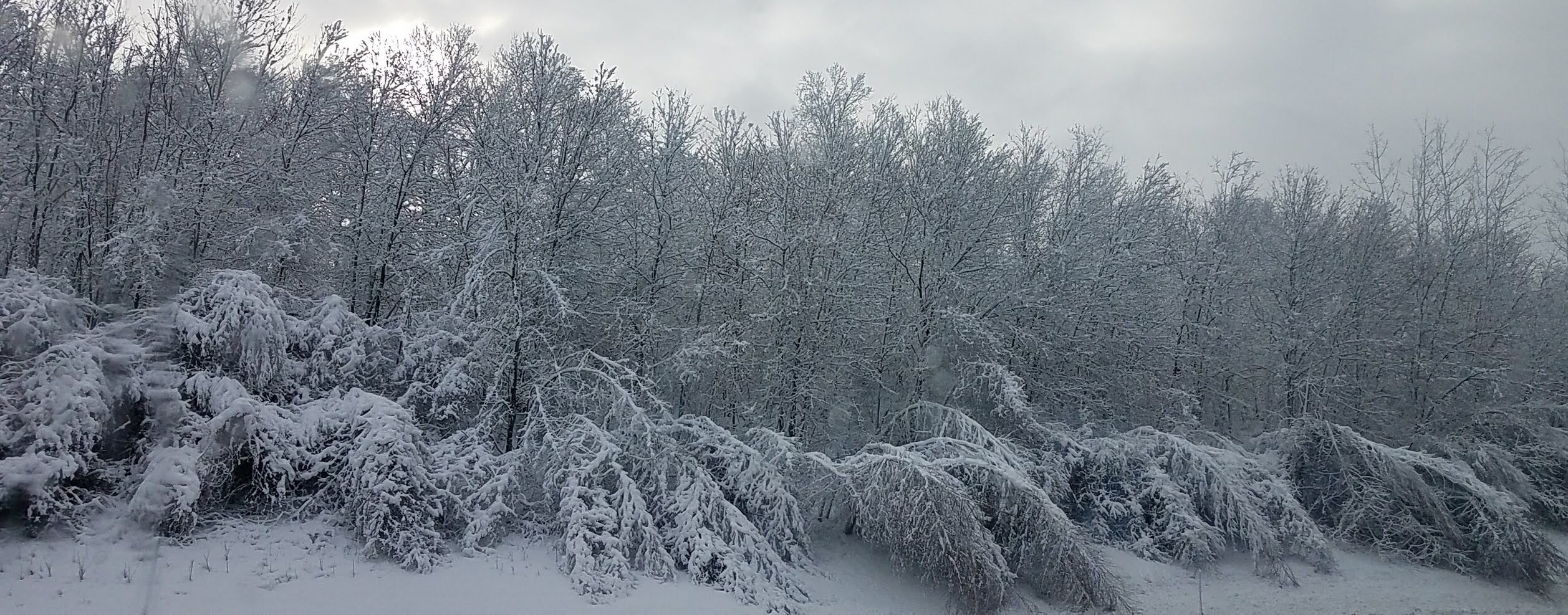
    The 1998 ice storm left a nice-looking white birch bent nearly 90°.  The tree was 7-8" diameter and had been 45-50 feet tall.  When I noticed it was lifting a bit, I tossed a rope over it about 25 feet from the stump, attached the rope to my come-along and to another tree.  Every few days I'd cinch up the rope and by mid-April the tree was back to nearly vertical.  We then moved to New Sharon on May 15 so I've no idea how that birch is doing now.

    About 2" here, with off-on light snow, temp low 20s.

    These small birches were bent over in the March 18 paste storm and are still bent crooked in 25

    20180308_092822.jpg

    • Like 5
  8. 9 minutes ago, Typhoon Tip said:

    wow. 

    Not intending to troll the timing here but ... I was just looking at the 12z NAM grid.  If those numbers are right for Friday, we're going above MOS and probably human interpretation on that day.  It's too early in the returning insolation to expect much assist, but +8C at 900 mb would send the temperature to 72F if this were mid February.   Don't know about January 9th... proooobably not.  Gossamer snow pack will prevent some recovery, too.

    If that NAM thermal profile is right, ton of midday sun and light WSW wind will be interesting for the temperature nerds like me. 

    Cloudy upper 40s

  9. 1 hour ago, 40/70 Benchmark said:

    Precisely as planned AFAIC....only wrinkle so far has been the huge -WPO ridge making December even colder than thought.

    Negative WPO was in the cards starting appearing beginning of November as many here pointed out. All signs pointed to colder solutions.  After a thaw can we make it a Pete Repete .Tack on the deep negative EPO balls cold. As the STS ramps up too. The elusive East Coast Mauler this year? 

    download (15).png

    download (16).png

  10. 10 hours ago, The 4 Seasons said:

    2 years ago today. The other big storm that season. A lot of the areas that jackpotted here missed out on the Feb 13th, 2024 snowstorm. A pretty insane gradient S to N with coastal SECT getting less than 1" to upwards of 17" in N Granby. Just got done re-doing this entire storm from scratch for accuracy and to include Lower Northeast map w/ climo sites. 

    https://www.jdjweatherconsulting.com/jan-6-7-2024

    01_06.24_jdj_v3_lower_northeast_hi_res_snowfall_totals.thumb.jpg.d89653190174ab183f1fb529739464d3.jpg


    Contours Only

    01_06.24_jdj_v3_lower_northeast_hi_res_snowfall_totals_contours_only.thumb.jpg.6d3e2a66afcb0c820270501ca68618d5.jpg


    Happy anniversary 

    FB_IMG_1767768775679.jpg

  11. 1 hour ago, weathafella said:

    That and probably genetics.  You have at least some longevity in your bloodline.  I attribute my own good fortune to pure luck. No one in my bloodline has made it out of their 70s.  

    I like dad bod…I’m gonna use that for me!  And one more thing/this winter is growing more sour by the day.

    Have faith young man we have recovered from worse even later. 

    • Like 1
    • 100% 1
  12. 7 minutes ago, ORH_wxman said:

    Ray, Feb 1956 and Feb 1972 were good and both La Nina...'56 was a strong Nina.

    I'm stil trying to find a similar pattern as to the one being forecasted by ensembles....I agree Feb 2014 is prob the closest but that had the lower heights biased further west....more of a -PNA than is currently being progged. Late Jan/early Feb 2013 is another somewhat similar pattern too. 


    Screenshot_20260106_161845_Chrome.jpg

    • Like 1
×
×
  • Create New...