Jump to content

ORH_wxman

Moderator Meteorologist
  • Posts

    91,248
  • Joined

  • Last visited

Everything posted by ORH_wxman

  1. Yeah I'd sign the dotted line right now if the MEI came in between 0.5-1.0 for the winter. Honestly, the weenie scenario is the MEI keeps lagging in that 0.5 range into December so we get less El Nino influence that month (thus helping the chances for colder/snowier solutions) and then it climbs more for Jan/Feb so we can get the great second half that often occurs with +ENSO. But my guess is still a mild December for now...I think the MEI will rise a decent amount over the next 2 months.
  2. Since I was comparing two sets of years against the same anomaly, it wouldn’t change anything on that plot I posted if we changed the baseline from 1991-2020 to another 30 year set. But if we compared one of the sets of years to a single baseline, then yes, it would change depending on the baseline we use. It is easier to get a below normal winter using 1991-2020 normals than using 1961-1990 normals since the latter is a much colder climo baseline.
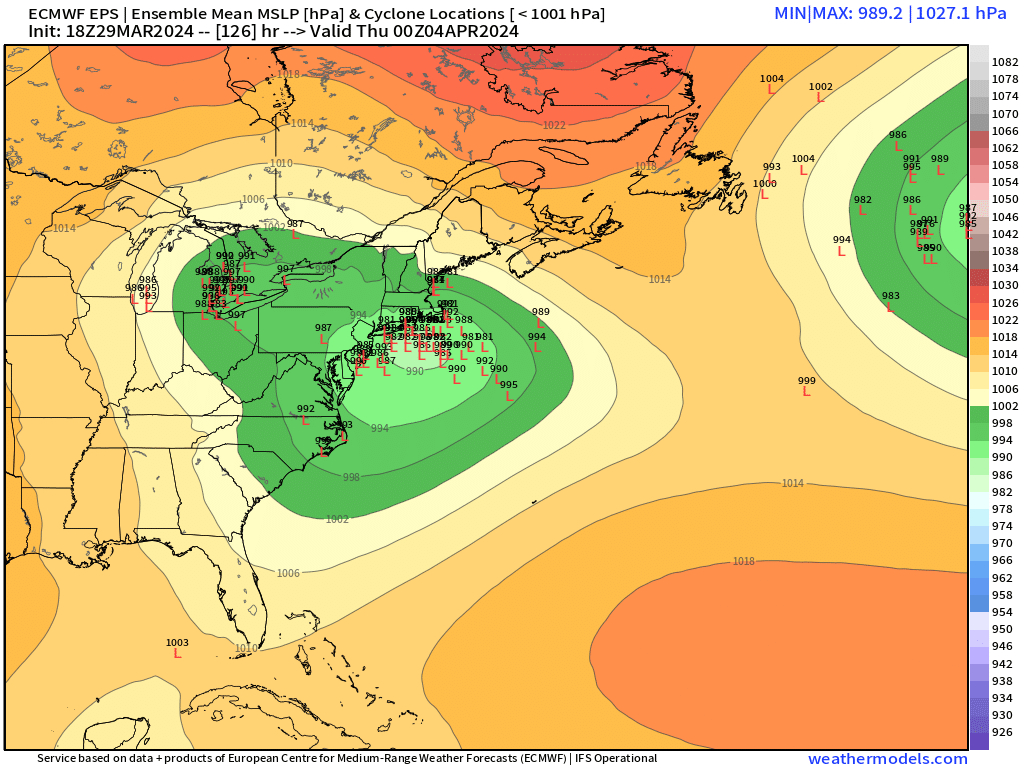
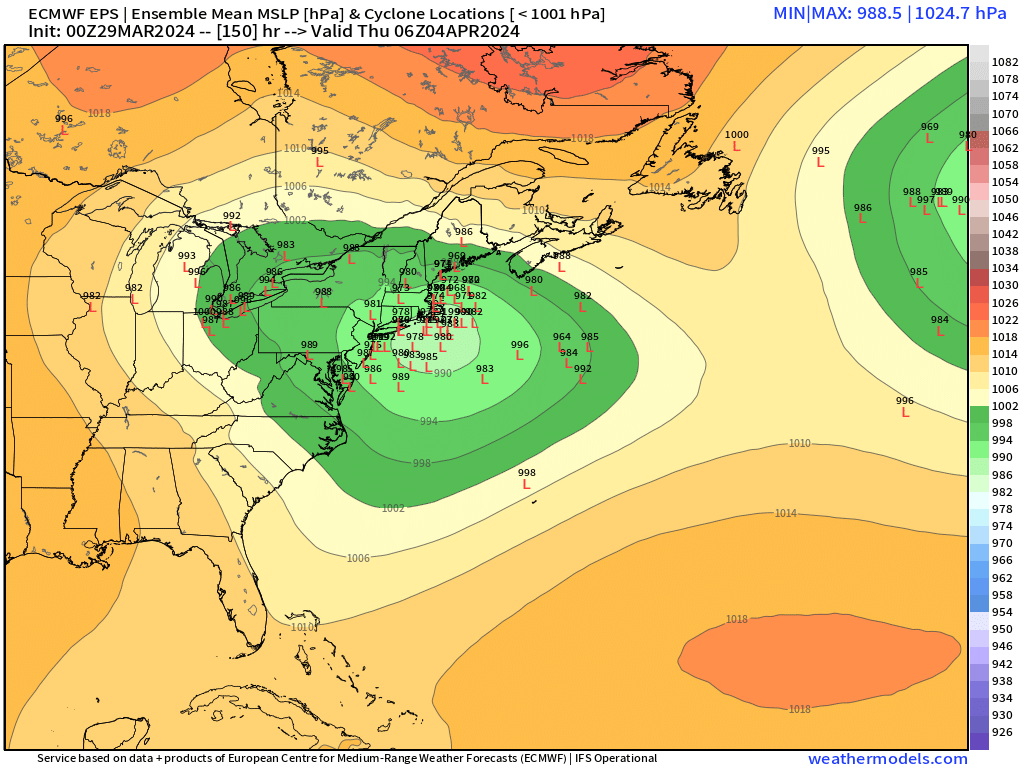
  3. I'd also say it is probably worthwhile to take a look at the evolution of the Dec 2022 block....as noted, you see the initial super deep PNA trough out west producing a huge ridge response in the east in the 7 day period leading up to the maturity of the block. Then as the block is starting to mature, we see a pretty typical height response underneath it....albeit, still some very deep height anomalies over the SW US. Then finally, the fully mature and beginning of the decay of the block in the 7 day period leading into Christmas....you'll note the height response still looks very good to the south, but that core of best anomalies is a bit too far west....did the block cause that or was it the very deep height anomalies in the SW US that led to this? OR maybe it was some of both? Hard to say for sure, but it was not a completely normal evolution given the extreme initial troughing out west.
  4. We actually had a discussion about 6-8 years ago on here (I'll have to see if I can find the exact thread) about how the deeper interior had been seeing declining snowfall (particularly bigger storms) while closer to the coast had seen increasing snowfall and the culprit or explanation given at the time by many in the thread was because of the predominantly -AO/-NAO patterns we had seen in recent winters.....due to? You guessed it, lower sea ice/AGW. Now we're seeing the opposite argument....deeper interior is cleaning up because of AGW-induced blocks further south. This is what causes so much skepticism in the pattern-attribution studies....it sounds a lot more like "Flavor of the month" because they don't maintain their dominant force for more than a few winters. I have no doubt that all else being equal, there is some attribution going on, but the problem is things don't remain equal for very long. Natural variability is still a very strong force which is why you can see a decade (or more) of colder winters over a large region than the previous decade despite underlying warming trends. If you adjusted your winter forecast temps much warmer in the 2000s/early 2010s because of the big warming trend we saw from 1980-2000, you would have looked like an idiot and been consistently too warm. Is it because climate change didn't exist? Nope...it was because you probably placed too much weight on it and not enough on other factors that easily overwhelm it in a given season.
  5. FWIW, here's the 2021 and 2019 patterns I was referring to And the temp anomalies:
  6. I think my main beef with your comparisons is assuming the Dec 2022 -NAO/-PNA pattern is the new norm or at least likely to be the dominant type of -NAO/-PNA pattern going forward....why are we ignoring the cold -PNA/-NAO pattern from late Jan to mid Feb 2021? Or what about the cold -NAO/-PNA pattern from mid Feb to early Mar 2019? Dec 2022 looks like more an outlier to me than a new paradigm.
  7. Here is 2001-2015 winter temps compared to the previous 15 years....climate change was happening during all of this, yet much of the central and eastern US was colder in the mean. We wouldn't claim it is due to global cooling...we would claim it is due to natural variation on top of the underlying warming trend....it happened to overwhelm it during that period relative to the previous 15 years. So yeah, it's not unreasonable at all to say that some of the warming the northeast has seen since 2015 is due to natural variation putting us in a more unfavorable pattern. I also reject that the pattern becomes more permanent. But we'll see. Maybe this is the one that actually does and all the others that failed to stay consistent (warm blobs, -AO due to sea ice, etc) were just flawed research.
  8. Area has been pretty flat over the last few days....up a little bit, but not quite enough yet to call the minimum with high confidence. We are currently at 2.72 million sq km which is 90k above the min back on 9/12. If we tick up to 2.8 million sq km in the next couple days, then I think it will be safe to call the min.
  9. Looks like really nice weather next week…great fall airmass.
  10. Yeah in the monthly mean it wasn’t as great as those previous examples but during the core period of favorability (those two weeks leading into Xmas), we did have a good height response below the block but we got unlucky with that phase out west prior to the 12/22-23 storm
  11. It’s gonna need to rise very quickly like ‘82 did to atmospherically behave like a super Nino but we’re already lagging behind ‘82…it could still get there if it did it like a month or two delayed but not sure if that is a long shot or not. Either way, this is going to be an instructional example.
  12. When we discuss attribution, we’re really discussing “net impact”…CC changes the weather so if we’re being extremely literal as in “butterfly theory”, then of course CC causes everything….it might have caused today to be a partly sunny day in Florida instead of a category 5 hurricane. That’s why we discuss net impacts. We know deep PNA troughs have dug into Baja California before so we can see how the patterns looked when that happened in the past and the compare it to a deep Baja CA trough in Dec 2022. Frankly, any dismissal of skepticism on attribution studies as someone denying CC at all is just as bad as someone actually claiming there is no effect. It’s usually a tactic to try and shut down discussion rather than engage using empirical evidence. Both are not scientific inquiry…and more like dogma.
  13. I agree with the loaded dice comment....I think where you and I probably fundamentally disagree the most is how much weight we are putting on these shorter term patterns. I view most of them as natural variation that exist on top of an underlying warming trend which CC enhances or mutes....which means that when we get a canonical warm pattern, its REALLY warm and when we get a canonical cold pattern, it's not as cold as the previous ones. It's why I refer back to earlier proclamations of regime shifts that didn't stand up over time. The "new hot thing" back in the 2009-2014 years was the "warm arctic, cold continents" pattern in winter that CC had driven because of low sea ice. Several peer-reviewed papers were published on this topic. There was legit discussion about how these patterns might be paradoxically more common because of CC.....then it all shifted away from that theory quite quickly in the following 8-9 years. Prior to that, we had peer reviewed literature talking about a semi-permanent +NAO/AO based on the big increase in those patterns in the 1980s/1990s....and then the 2000s of course shifted the other way. Now maybe CC has caused a near-permanent SE ridge which means 2016-2023 is the new normal....again, I would bet against that, but maybe this time it will stand the test of time unlike the previous shifts. I do think it's good to look at the effects of SST warming in regional spots....but at the same time, warming is not evenly distributed on a temporal/spacial scale and relative changes will cause certain areas to cool or warm differently than perhaps they did in the previous decade or two. Prior to the mid-2000s, the fastest warming region in the CONUS was the upper plains/Rockies....now they are the slowest warming region in the CONUS while New England and SE Canada are the fastest.
  14. I think it's good to try and discuss the impacts....so I don't mind these discussions. I've seen a lot of over-attribution in the last 15 years to specific patterns that then change and we stop hearing about them for a while and we move onto the next attribution study. CC is related to all this in some form, but untangling it from natural variation is hard when it comes to specific pattern regimes....and this is doubly true when we are discussing 8 year chunks. That's a terribly small sample to make a lot of longer term conclusions from. We know what the longer term trend is, but trying to "Adjust" our projections of temperature changes or pattern changes based on very short timescales has it's major drawbacks. I know the longterm trend for ORH temperatures in DJFM is 0.4F per decade....but if we use only the trend since 2008, then it's at 2F (!!) per decade. So that's the end of the debate, right? We can assume it's going to be 2F per decade over the next 20 years or so? Nope, if we did the exact same exercise from 1985-2000, the trend was also 2F per decade....but then the next 15 years was actually a negative trend of -1.1F per decade. In the mean, the positive trends will outweigh the negative trends, but from an empirical standpoint, there is no evidence that they just continue unabated. I'm certainly open to some "tipping point" that has permanently given us a Philadelphia winter climate, but I would obviously treat such claims with extreme skepticism and they should be until evidence is way stronger.
  15. Actually not a terrible match over North America, though the PNA trough is deeper in 2022-23 and the NAO block is in a much better spot in '55-56 for northeast snow (west based near Hudson Bay and Baffin).
  16. When I look at the most recent 8 winters and compared them directly to the previous 8, I see a larger scale regime shift in the polar domain and the PNA region....that's by far the primary cause of warmth to me in the northeast and not underlying CC change. The underlying CC trend makes our patterns warmer than they used to be all else equal, but it is not the primary driver of this type of shift we see where heights are lower in the NAO region and PNA region and higher over the east coast. Now, maybe you are arguing that CC caused the PNA trough to dip so far south that Pasadena and many other areas that hardly ever get cold enough were getting snow? Maybe....that's a bold claim.... but I haven't seen compelling evidence on that front. I buy that the downstream ridging is warmer in a warmer world, but that still doesn't explain the larger regime shift which we have seen historically. Are you arguing that this new paradigm in the last 8 years is a permanent feature? I'd bet against that for sure. It doesn't mean we will go back to averaging 2008-2015 temps, but that same pattern would still be significantly colder than the 2016-2023 pattern even with underlying CC warming.
  17. Agreed...but Ray's point is that this was pretty extreme. It wasn't solely because of some underlying trend...otherwise it would have been very visible prior to just the last few years. The underlying height trend helps exacerbate strong ridge response when you get a deeply negative PNA trough out west, but it's not the primary cause of the event in the first place. When Pasadena CA is getting snow, it was probably a tough lift even in 1955 to get good snows in New York City in that pattern.
  18. Data retrieval has gotten significantly worse in the past 2 years. Pretty frustrating since it should be easier considering the raw concentration daily data is available on NSIDC. It's just nobody is putting into numeric form anymore.
  19. I like warm falls these days, but still want a couple cold shots to kill the bugs and remind us winter is getting close. I usually like to see first flakes in late October or early November. Those frigid Septembers back in the late 1980s/early 1990s were useless. (except seeing snow on the last day of Sept 1992....that actually was pretty awesome)
  20. Unless there was a revision to past area, I have 2023 as 4th lowest. Either way, this is one of the stronger late melts on record post-August 1st. 2012: 2.228429 2016: 2.463209 2020: 2.5859 2023 low so far is 2.63, but it's only at 2.67 right now, so it could fall further into 3rd still. The area file I used to reference is no longer active, so I don't have a good way to look up revisions. But I do have the old data saved. Is there a good archive of the data somewhere now? I only have cryosphere computing, but that only gives us a single day shot and doesn't seem to archive the daily numbers.
  21. Yeah they are definitely “seeing” something. But it’s hard to weight it too much this far out. If it stays that way when November updates are coming out, then I’ll be more intrigued.
  22. I wouldn’t much stock in any of the seasonal models yet. If they are still all agreeing with eachother in November then I think there’s probably some predictive skill….but there’s been so many times they just shat the bed.
  23. I dunno. You just told me the Baffin differences Re: 2009 vs 2023 were due to high Atlantic SSTs….that seems like a claim very similar to my other examples which haven’t held up over time. Also, doesn’t the literature show a lot more cloudiness in recent years over the arctic high latitudes? That wouldn’t square with more sunshine being the primary culprit in heating the sfc. But I also realize these debates are better suited for another thread rather than detracting from the ENSO discussion.
  24. Yeah I disagree with his attribution claims RE: 2009 vs 2023. I’ve found over and over again that SSTs being blamed for extreme patterns seems to not hold up against time. We saw this with the low sea ice (which makes the sfc much warmer in the arctic) claims as being the reason for big -AO patterns in the 2009-2013 period or the Pacific warm blob being blamed for the exceptional PNA ridging in 2014 and 2015. Local SST anomalies can enhance a mid-latitude pattern, that is pretty well known…but they are almost never the primary cause. The only region where the literature is extremely robust is in the tropical pacific…though that doesn’t affect a pattern directly by raising heights, but rather it does it mostly through convection.
×
×
  • Create New...